

Protecting Seniors From Tech Support Scams: How to Spot, Prevent, and Report Fraud
Tech support scams stole more than $1 billion from American seniors in 2025, the second-largest elder fraud category. Criminals impersonate Microsoft, Apple, Norton, or your bank’s fraud department — using fake browser pop-ups, unsolicited calls, or emailed “refund” invoices — to trick older adults into granting remote computer access or withdrawing cash for a courier. The single best defense: never call a phone number that appears in a pop-up, and never let anyone you did not contact first remote into your computer.
Last updated: May 15, 2026 · Primary sources: FBI IC3 2025 Annual Report, FTC, DOJ Elder Justice, plus our news corpus of 1,910 parseable elder-fraud articles.
- What Is a Tech Support Scam Targeting Seniors?
- How Do Tech Support Scams Work?
- Common Tactics in Tech Support Scams
- US Heat Map – Tech Support Scam Targeting Seniors (2024)
- 2025 Data Update — State Rankings
- Red Flags of a Tech Support Scam
- Why Are Seniors Targeted?
- How to Protect Yourself
- If You Suspect a Tech Support Scam
Tech support scams cost American seniors over $1 billion in 2025, making them the second-costliest elder fraud category. With more than 21,300 victims, tech support fraud has one of the highest victim counts of any scam targeting older adults (second only to phishing/spoofing). This guide explains how tech support scams work, the red flags to recognize, and how to protect yourself from fake pop-ups, suspicious calls, and remote access schemes.
Already been scammed? Read our First 24 Hours Emergency Guide for critical steps to take immediately.
Audience-Specific Guides: Tech support scams hit specific audiences in specific ways. See our: Caregiver Scam Defense Center — for adult children helping a parent after a tech support scam; VA Login & Identity Theft Scams — VA.gov, Login.gov, and ID.me-specific tech support impersonation; Rural Senior Scam Protection — tech support scams in rural areas with limited cyber-fraud enforcement.
Not sure what a term means? Our Scam & Cybersecurity Glossary explains 77 common scam and cybersecurity terms in plain English.
2025 FBI IC3 Data Update: Tech support fraud remains the #2 costliest scam targeting seniors. In 2025, older adults lost $1.04 billion to tech support scams, with over 21,300 victims — the second-highest victim count of any fraud category (after phishing/spoofing). Scammers increasingly use pop-up alerts, phone calls, and remote access tools to steal from seniors. See the updated state-by-state data below.
What Is a Tech Support Scam Targeting Seniors?
A tech support scam targeting seniors is a type of fraud in which criminals pretend to be technical support agents from well-known technology companies (such as Microsoft, Apple, or your internet provider) to trick older adults into giving them money, personal information, or remote access to their computers. These scams use fear, urgency, and confusion to convince seniors that their devices are infected or compromised—and only the scammer can fix it.
How Do Tech Support Scams Work?
Scammers may contact seniors by:
- Making unsolicited phone calls (“cold calls”) claiming to detect viruses or problems on the victim’s computer
- Sending pop-up warnings that appear on a computer or phone screen, often flashing messages like “Your computer is infected!” or “Call this number immediately!”
- Using emails or text messages that look like official alerts from tech companies
Once contact is made, scammers will often:
- Claim the victim’s computer, phone, or accounts are at immediate risk
- Offer to “fix” the problem for a fee, subscription, or by selling fake software
- Request remote access to the victim’s computer, allowing them to steal personal or financial data
- Ask for payment via credit card, wire transfer, gift card, or cryptocurrency
Common Tactics in Tech Support Scams:
- Using official-sounding language and logos to appear credible
- Creating a sense of urgency (“Your bank account will be frozen unless you act now!”)
- Discouraging victims from seeking outside help or verification
- Installing malware or spyware if remote access is granted
US Heat Map – Tech Support Scam Targeting Seniors (2024)
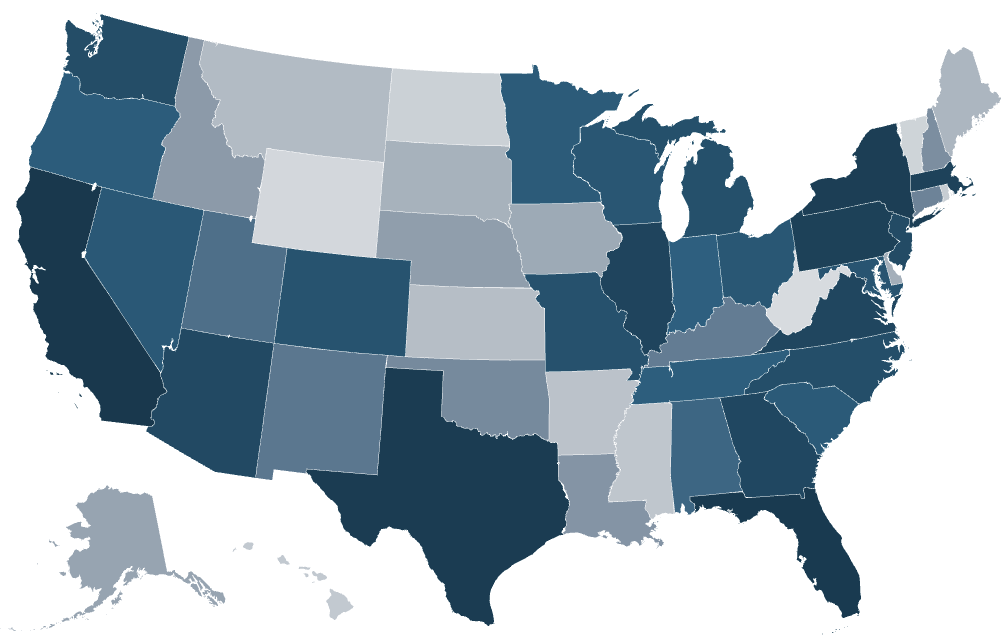
2025 Data Update — Tech Support Scam Losses by State
Source: FBI IC3 2025 Annual Report. National total: $1,040,730,043 in losses from 21,333 senior victims. View all crime types on the national hub page.
| Rank | State / Territory | 2025 Loss | 2024 Loss | Change |
| 1 | California | $169,531,132 | $191,067,028 | -11% |
| 2 | Florida | $122,218,354 | $73,817,666 | +66% |
| 3 | Texas | $92,484,764 | $48,187,907 | +92% |
| 4 | New York | $62,306,320 | $45,969,834 | +36% |
| 5 | Arizona | $41,322,689 | $19,867,457 | +108% |
| 6 | Maryland | $36,714,638 | $12,682,941 | +189% |
| 7 | Pennsylvania | $35,453,804 | $30,806,443 | +15% |
| 8 | Minnesota | $35,035,169 | $9,214,800 | +280% |
| 9 | Illinois | $34,412,473 | $22,291,747 | +54% |
| 10 | New Jersey | $27,447,012 | $19,536,766 | +40% |
| 11 | Virginia | $27,440,320 | $20,506,407 | +34% |
| 12 | Michigan | $23,954,602 | $14,156,274 | +69% |
| 13 | Washington | $23,831,892 | $16,722,142 | +43% |
| 14 | Georgia | $23,131,887 | $20,369,965 | +14% |
| 15 | North Carolina | $22,774,888 | $14,890,157 | +53% |
| 16 | Ohio | $22,019,506 | $10,931,422 | +101% |
| 17 | Massachusetts | $19,321,368 | $28,665,238 | -33% |
| 18 | Indiana | $18,267,082 | $7,611,943 | +140% |
| 19 | Kentucky | $14,904,656 | $6,006,877 | +148% |
| 20 | Colorado | $14,510,499 | $13,837,547 | +5% |
| 21 | South Carolina | $13,880,405 | $9,882,942 | +40% |
| 22 | Oregon | $13,556,085 | $8,080,035 | +68% |
| 23 | Wisconsin | $12,868,541 | $11,955,199 | +8% |
| 24 | Missouri | $12,478,669 | $14,117,451 | -12% |
| 25 | Nevada | $12,041,871 | $10,885,673 | +11% |
| 26 | Tennessee | $11,739,936 | $8,070,194 | +45% |
| 27 | Connecticut | $10,961,283 | $5,048,004 | +117% |
| 28 | New Mexico | $10,277,973 | $7,166,184 | +43% |
| 29 | Utah | $10,179,342 | $7,409,252 | +37% |
| 30 | Alabama | $8,297,741 | $7,603,438 | +9% |
| 31 | Louisiana | $8,291,885 | $4,106,472 | +102% |
| 32 | Oklahoma | $7,625,674 | $4,791,411 | +59% |
| 33 | Nebraska | $6,703,549 | $3,272,174 | +105% |
| 34 | Maine | $6,256,335 | $2,384,469 | +162% |
| 35 | Iowa | $5,965,199 | $3,019,088 | +98% |
| 36 | Idaho | $5,605,328 | $3,314,496 | +69% |
| 37 | Hawaii | $4,779,321 | $1,779,696 | +169% |
| 38 | Arkansas | $4,284,179 | $2,001,623 | +114% |
| 39 | Kansas | $4,149,467 | $2,157,320 | +92% |
| 40 | West Virginia | $3,271,772 | $770,600 | +325% |
| 41 | Rhode Island | $3,219,973 | $1,560,334 | +106% |
| 42 | New Hampshire | $3,047,618 | $4,521,639 | -33% |
| 43 | South Dakota | $3,018,006 | $2,479,460 | +22% |
| 44 | Delaware | $2,924,979 | $2,540,564 | +15% |
| 45 | Vermont | $2,701,557 | $1,150,772 | +135% |
| 46 | Montana | $2,399,047 | $2,309,586 | +4% |
| 47 | Alaska | $2,140,058 | $3,036,319 | -30% |
| 48 | Mississippi | $1,981,853 | $1,822,203 | +9% |
| 49 | District of Columbia | $1,293,437 | $245,293,375 | -99% |
| 50 | North Dakota | $1,293,253 | $1,191,657 | +9% |
| 51 | Wyoming | $1,030,220 | $799,175 | +29% |
| 52 | Puerto Rico | $76,346 | $158,869 | -52% |
Red Flags of a Tech Support Scam:
- Unexpected pop-up messages or calls claiming your device is infected
- Requests to download software or give remote access to your computer
- Demands for immediate payment, especially via gift cards or wire transfer
- Offers for technical help you didn’t request
- Callers become aggressive or threatening if you hesitate
Why Are Seniors Targeted?
- Scammers assume seniors may be less familiar with technology or more trusting of “authority figures”
- Many seniors rely on their devices to connect with family, making tech disruptions more stressful
How to Protect Yourself:
- Remember: Legitimate tech companies do not make unsolicited support calls or send pop-up warnings with phone numbers
- Never give control of your computer or provide payment information to someone who contacts you out of the blue
- Ignore or close suspicious pop-up windows—never call the number displayed
- If in doubt, contact your device or software provider directly using a verified phone number from their official website
- Regularly update your security software and run scans
- You can follow our training to further enhance your knowledge and skills against tech support scam.
If You Suspect a Tech Support Scam:
- Hang up immediately if you receive an unsolicited tech support call
- Do not click on suspicious pop-ups or download unknown software
- If you gave access or paid money, contact your bank immediately and run a virus scan
- Report the scam FBI’s Internet Crime Complaint Center (ic3.gov), and your local law enforcement
Remember: Real tech support never cold calls or asks for payment in gift cards. When in doubt, slow down and ask a trusted family member or friend for help.
Documented Tech Support Scam Cases
Three reported cases drawn from federal indictments, sentencings, and news investigations — with identifying details removed and described by age, locale, dates, and dollar amounts — illustrating how tech support scams play out against older adults in practice.
Federal “Save Our Seniors” initiative — $11 million in losses across 139 victims (Sept. 2025)
U.S. Attorneys announced a multi-state initiative dismantling tech-support and government-impersonation rings targeting seniors. Two money mules operating in western New York were charged with wire fraud and money laundering tied to $276,000 in losses. Among the named victims: an 81-year-old man defrauded of $38,000 in a fake Microsoft “refund error” scam, and a 68-year-old Buffalo woman who lost nearly $20,000 after a tech-support scammer convinced her to withdraw cash and hand it to a courier. The Save Our Seniors initiative uncovered $11 million in total losses across 139 victims nationwide. Source: WKYC-TV / U.S. Attorney’s Office WDNY, Sept. 19, 2025.
An 83-year-old on Long Island — $20,000 lost in a fake-refund tech support scam (Dec. 2024)
An 83-year-old woman on Long Island received an email invoice for $391.41 from an “anti-malware service” just after canceling her subscription. When she called the number on the bill, scammers took remote access of her computer, then manipulated her screen to show that $40,000 had been mistakenly refunded into her account. They threatened her with jail unless she returned the “overage.” Frightened, she withdrew $20,000 in cash from a local bank branch and handed it to a courier sent to her home. She filed a police report; recovery has been minimal. Source: Newsday, Nov. 10, 2025.
Carlsbad, CA woman — $1.49 million laundered through gold-bar “safekeeping” scheme (Dec. 2025)
A Carlsbad, California woman lost $1.49 million after a pop-up on her computer claimed she had been hacked. Scammers transitioning between roles — tech support, “bank” officials, then “federal” agents — convinced her the safest place for her savings was gold bars stored in a fictitious U.S. Treasury “locker.” Over two months she converted $1,335,000 to gold and handed the bars to couriers. Two defendants pleaded guilty in federal court. Source: CBS 8 San Diego, Dec. 4, 2025.
Frequently Asked Questions
Plain-English answers to the questions older adults, caregivers, and journalists ask most about tech support scams targeting seniors.
What is a tech support scam?
A tech support scam is a fraud where criminals pose as Microsoft, Apple, Norton, your bank’s fraud team, or a federal agency to convince you your computer is infected or your account has been hacked. They then ask for remote access, your banking credentials, or for you to withdraw cash to “protect” it. In 2025 the FBI recorded over $1 billion in losses from victims age 60+.
How do fake pop-up tech support scams work?
A pop-up appears in your browser claiming your computer is infected, sometimes with sirens or a phone number in large text. The page is fake. Calling the number connects you to a scammer who will request remote access (often via AnyDesk, TeamViewer, or LogMeIn), then show you fake “errors” while moving money out of your accounts. Close the browser entirely — do not call the number.
Should I call the phone number in a tech support pop-up?
Never. Legitimate companies do not display phone numbers in pop-ups warning of infection. If you are worried, restart your computer and run an antivirus scan you already trust. To call Microsoft or Apple support, go directly to support.microsoft.com or support.apple.com in a new browser window.
What if I already gave a scammer remote access?
Disconnect from the internet immediately (unplug ethernet, turn off Wi-Fi). Then power off the computer. From a different device, change passwords on email, banking, and any account stored in a password manager. Call your bank’s fraud line. Run a full antivirus scan before reconnecting the original computer. Report at ic3.gov and reportfraud.ftc.gov.
Why do scammers ask seniors to withdraw cash and hand it to a courier?
Cash hand-offs leave no paper trail, are nearly impossible to claw back, and bypass bank fraud-detection systems. A common script: scammer convinces the victim that a hacker is in their bank account, then offers to “protect” the money by having them withdraw it and hand it to a “federal agent” or “courier” for safekeeping. No legitimate bank, government agency, or law-enforcement officer will ever ask this.
What is the “refund” tech support scam?
A scammer claims you are owed a refund for a canceled subscription. They ask for remote access to process it, then show a fake screen suggesting they accidentally refunded too much — e.g., $40,000 instead of $400. They demand you return the “overage” via wire, gift cards, or cash. The original $40,000 was never sent; the screen was manipulated. This is the pattern documented in the Newsday-reported Long Island case.
Are tech support scams covered by my bank?
Generally no — banks treat authorized withdrawals (even those obtained through scam coercion) as the customer’s responsibility, especially for cash withdrawals and wire transfers. Some banks have improved policies for fraud-related ACH and Zelle disputes, but recovery is not guaranteed. Fast reporting (within 24–72 hours) improves odds. Federal authorities (FBI IC3, FTC) cannot directly refund victims but their reports can contribute to prosecutions that result in restitution.
How can I help an elderly parent avoid tech support scams?
Set up the family computer with an ad and pop-up blocker (uBlock Origin or similar). Disable browser notifications that scammers exploit. Pre-program legitimate support phone numbers into their phone. Have a standing rule: any pop-up or unexpected call about computer security gets discussed with you before any action. See our family caregiver guide for the full framework.
State-Specific Tech Support Scam Resources
Find detailed tech support scam prevention guides and local reporting contacts for your state:
- California Tech Support Scam Resources – $169.5M lost by CA seniors in 2025 (down 11% from $191M in 2024)
- Texas Tech Support Scam Resources
- Florida Tech Support Scam Resources
- New York Tech Support Scam Resources
- Arizona Tech Support Scam Resources
- Pennsylvania Tech Support Scam Resources
- Vermont Tech Support Scam Resources
View national elder fraud statistics | Find your state Attorney General
Real cases (anonymized from public news coverage)
Recent tech-support scam cases drawn from public news reporting. Names and identifying details have been removed. Tech-support scams have evolved from simple pop-up tricks into multi-day, multi-impersonator schemes — see our Phantom Hacker pillar for the full three-phase version.
January 2026 — New York Times reporting. An 87-year-old retired lawyer searched online for Microsoft tech support and called the first phone number that appeared at the top of the results. He spent nearly five hours on the phone with the scammer, who installed remote-access software and ultimately wired $85,000 from his checking account. The bank later declined to reimburse him because the transfer was made under his own credentials. As reported by AOL (citing The New York Times).
November 2025 — San Diego County, California. A senior couple received a pop-up message on their computer that appeared to be a Microsoft virus warning and called the number listed. They were passed from a ‘support technician’ to a ‘Chase fraud investigator,’ who instructed them to deposit funds into what was described as a ‘Federal Trade Commission locker’ for safekeeping. They lost $35,000. The county DA’s office reported a combined $130 million in elder-fraud losses across San Diego County in a single year. As reported by CBS 8 News.
February 2026 — Western District of North Carolina (federal case). Three defendants were sentenced in federal court for their roles in an international, multi-million-dollar tech-support fraud scheme. The defendants received prison terms for participating in the operation, which targeted elderly victims by impersonating support staff at major technology companies. As reported by DOJ press release.
Recent news coverage
Selected recent news coverage on tech support scam scams targeting older adults. Updated from our ongoing monitoring of US news sources.
- Apr 2026 — Identity theft losses surge 70% for older Americans — Fox News (Fox News)
- Mar 2026 — Top senior scams and how to avoid them — AOL.com (AOL)
- Mar 2026 — Florida man allegedly stole 71-year-old nurse’s home and $300K through power of attorney (Yahoo Finance)
- Feb 2026 — The Top Scams Retirees Fall For Every Time — AOL.com (AOL)
- Feb 2026 — ‘Gold bar scam’ targeting elderly cost Texas man $2M, family says — Yahoo Finance (Yahoo Finance)
- Feb 2026 — How to Spot and Avoid Scams Targeting Older Adults (AOL)
Related guides on this site
- Real cases where senior scam victims got their money back
- DOJ Elder Fraud Prosecutions Tracker
- Bitcoin ATM & Crypto Kiosk Scams
- P2P Payment Scams (Zelle, Venmo, Cash App)
- Emergency: scammer got remote access
Sources & verification. Published by HCSK Inc. The information on this page is based on official federal data from the FBI Internet Crime Complaint Center (IC3), the Federal Trade Commission (FTC), and the U.S. Department of Justice. We last checked these figures against the original government sources in June 2026.
The national picture. These scams are part of a much bigger story. In 2025, Americans 60 and older reported losing $7.748 billion to online fraud across 201,266 victims. Read Stolen Trust, our 2026 special study that maps the full elder-fraud landscape, with five years of FBI data and one practical plan to fix it.
Recent Tech Support Scam News
Recent tech support-scam news affecting seniors, updated from our alerts desk. Each item links to the original outlet; victims and defendants are kept anonymous.
Florida's Operation Senior Shield: tech support shouldn't take control of your device
Florida's Operation Senior Shield is warning residents about tech-support scams in which callers or fake pop-up alerts pose as Microsoft, Apple, or another trusted company and pressure people to install remote-access software like AnyDesk or TeamViewer, handing the caller full control of their device. Once inside, scammers can view files, move money, or lock the owner out entirely, often demanding payment in gift cards or cryptocurrency to "fix" a problem that never existed. The advice: stop and verify before responding to any unexpected tech-support message or call, and never let anyone you did not contact yourself take remote control of your computer or phone. Suspected scams can be reported to ReportFraud.ftc.gov, the FBI's IC3.gov, or the Identity Theft Resource Center.
Read at Alachua Chronicle →A Redwood City, California woman's suspicion stopped a scam before she lost a cent
A Redwood City, California woman received fake messages claiming to be from Apple's fraud alert system, warning of unauthorized charges on her bank account, and was told to withdraw cash and have a courier pick it up from her home. Instead of complying, she grew suspicious and contacted police right away. Officers worked with her to set up a plan and were able to intervene before any money changed hands; the woman lost nothing. Police say the case is a clear example of why calling law enforcement before withdrawing or handing over any money, rather than after, gives investigators the best chance to stop a scam in progress. If you get an unexpected alert like this, do not call any number in the message; hang up, and verify by contacting the company or your bank directly using a number you look up yourself.
Read at Redwood City Pulse →New Hanover County, North Carolina officer stops an 89-year-old's $9,000 crypto scam at a gas station
An 89-year-old New Hanover County, North Carolina woman received a fake message claiming she owed $390 to Geek Squad, and the scammers escalated from there, eventually telling her she needed to send $10,000 to fix a problem with a supervisor. She had already withdrawn more than $9,000 in cash and was at a Bitcoin ATM at a local gas station when a Wilmington police officer noticed she did not fit the profile of someone who normally uses these machines and stopped to ask questions. He walked her to the actual repair shop to confirm the message was fake, then escorted her to her bank, where the $9,000 was returned to her account. Police remind residents that no legitimate company or agency will ever demand payment through a Bitcoin ATM, gift cards, or cryptocurrency.
Read at WWAY TV3 →Wilmington, North Carolina officer stops a $10,000 crypto scam in progress at a gas station
A Wilmington Police Department officer on a routine gas station patrol noticed an elderly woman standing at a Bitcoin kiosk with thousands of dollars in cash while on her cellphone, a telltale sign of a crypto scam in progress. Scammers posing as tech support had convinced her a problem needed to be fixed by withdrawing cash and depositing it into the machine. The officer asked her to stop the deposit, took her phone to confront the callers directly, and stopped the transfer before any money was lost. Police remind residents that no legitimate business or government agency will ever ask for payment through a Bitcoin machine, gift cards, or cryptocurrency; if you're ever told to do this, slow down, hang up, and call police before sending anything.
Read at WWAY TV3 →New York Daily News: a former investigator on protecting seniors from financial fraud
A 23-year law-enforcement veteran writes in the New York Daily News about protecting older adults from fraud after his own father lost most of his parents' life savings: a fake invoice led him to call a bogus 'customer service' number run by a criminal syndicate. The lesson is that anyone can be caught, so verify any unexpected invoice or support number through the company's real, published contact details.
Read at New York Daily News →These online groups may infect your device with spyware
Police warn that joining certain social media groups can install spyware that quietly steals your data.
Read at Caledon Enterprise →