

Protecting Seniors From Romance Scams: How to Spot, Prevent, and Report Fraud
Romance scams stole $584 million from American seniors in 2025. Criminals build months-long online relationships — through dating apps, Facebook, WhatsApp, or messaging platforms — then introduce a crisis (illness, customs fees, stranded travel) requiring money the victim sends out of love. AI now generates photorealistic profile photos and chatbots that maintain emotionally convincing conversations around the clock. The single best defense: never send money or share financial information with someone you have not met in person, no matter how long you have been talking.
Last updated: May 15, 2026 · Primary sources: FBI IC3 2025 Annual Report, FTC, DOJ Elder Justice, plus our news corpus of 1,910 parseable elder-fraud articles.
- What Is a Romance Scam Targeting Seniors?
- How Do Romance Scams Work?
- Common Tactics in Romance Scams
- US Heat Map – Romance Scam Targeting Seniors (2024)
- 2025 Data Update — State Rankings
- Red Flags of a Romance Scam
- Why Are Seniors Targeted?
- How to Protect Yourself
- If You Suspect a Romance Scam
Romance scams cost American seniors $584 million in 2025, with over 10,100 victims aged 60 and older. AI-generated photos and deepfake video calls are making these scams harder to detect than ever. This guide covers the warning signs of romance fraud, prevention strategies, and steps to take if you suspect someone is being targeted.
Already been scammed? Read our First 24 Hours Emergency Guide for critical steps to take immediately.
Audience-Specific Guides: Romance scammers target specific audiences with specific patterns. See our: Surviving Spouse Scam Protection — recent widows and widowers are explicitly targeted in the months after a spouse’s death; Senior Veterans Scam Protection — military impersonation using stolen service-member photos is a dominant pattern; Caregiver Scam Defense Center — for adult children helping a parent in a suspected romance scam.
Not sure what a term means? Our Scam & Cybersecurity Glossary explains 77 common scam and cybersecurity terms in plain English.
2025 FBI IC3 Data Update: Romance scams cost seniors $584 million in 2025. Over 10,100 seniors were victimized. AI-generated photos and deepfake video calls are making romance scammers harder to detect than ever. See the updated state-by-state data below.
2026 Update: Romance Scams in 2026: How AI Makes Fake Love More Convincing Than Ever — Learn how criminals are using AI to create more believable romance scams.
What Is a Romance Scam Targeting Seniors?
A romance scam targeting seniors is a type of fraud where criminals create fake romantic relationships with older adults, usually online, to gain their trust and then exploit them for money, gifts, or personal information. These scams often prey on seniors’ loneliness, trust, or recent loss of a spouse or partner.
How Do Romance Scams Work?
Scammers typically contact seniors through:
- Dating websites or apps
- Social media platforms (like Facebook, Instagram, or even Words With Friends)
- Email, text messages, or even phone calls
Once contact is made, the scammer will:
- Develop a relationship over weeks or months, using frequent, affectionate communication
- Share fake photos and personal stories to appear genuine
- Express strong feelings quickly and talk about future plans together
- Avoid meeting in person, often claiming to live or work far away (overseas, in the military, or on a ship)
Eventually, the scammer invents an emergency or opportunity that requires money, such as:
- Needing help with medical bills, travel expenses, or legal trouble
- Claiming to need money to visit the victim or return home
- Asking for gift cards, wire transfers, or cryptocurrency
Common Tactics in Romance Scams:
- Building trust through daily, loving messages
- Using stolen or fake photos to create a convincing profile
- Making excuses to avoid phone or video calls, or in-person meetings
- Creating urgent stories to pressure for money (“I’ll lose my job if I can’t pay this fee!”)
US Heat Map – Romance Scam Targeting Seniors (2024)
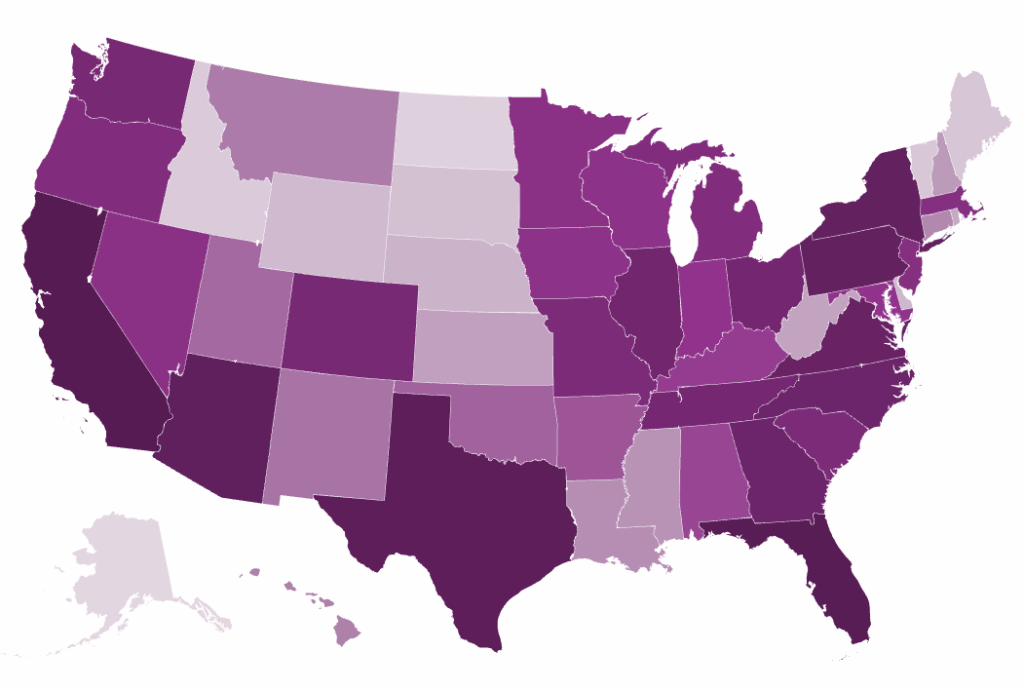
2025 Data Update — Romance Scam Losses by State
Source: FBI IC3 2025 Annual Report. National total: $584,032,745 in losses from 10,188 senior victims. View all crime types on the national hub page.
| Rank | State / Territory | 2025 Loss | 2024 Loss | Change |
| 1 | California | $100,861,373 | $50,734,540 | +99% |
| 2 | Florida | $52,066,239 | $36,522,146 | +43% |
| 3 | Texas | $48,305,099 | $36,483,347 | +32% |
| 4 | Arizona | $40,228,954 | $30,891,882 | +30% |
| 5 | New York | $28,494,780 | $21,113,070 | +35% |
| 6 | Pennsylvania | $20,180,681 | $19,302,412 | +5% |
| 7 | Virginia | $16,892,135 | $13,762,434 | +23% |
| 8 | New Jersey | $15,297,784 | $7,758,146 | +97% |
| 9 | Georgia | $15,275,922 | $12,612,159 | +21% |
| 10 | Illinois | $14,770,418 | $12,182,142 | +21% |
| 11 | Washington | $14,410,706 | $10,806,861 | +33% |
| 12 | North Carolina | $14,261,724 | $12,785,251 | +12% |
| 13 | Missouri | $13,656,534 | $9,670,487 | +41% |
| 14 | Oregon | $12,654,741 | $9,280,510 | +36% |
| 15 | Indiana | $12,531,072 | $4,560,033 | +175% |
| 16 | Montana | $12,524,287 | $2,291,700 | +447% |
| 17 | Tennessee | $12,137,627 | $10,992,966 | +10% |
| 18 | Ohio | $12,122,050 | $11,589,540 | +5% |
| 19 | Colorado | $11,765,682 | $9,679,627 | +22% |
| 20 | South Carolina | $9,671,081 | $9,447,981 | +2% |
| 21 | Michigan | $8,956,361 | $8,154,475 | +10% |
| 22 | Massachusetts | $8,695,064 | $6,756,955 | +29% |
| 23 | Alabama | $8,034,437 | $3,648,378 | +120% |
| 24 | Maryland | $8,029,430 | $4,424,939 | +81% |
| 25 | Minnesota | $7,969,936 | $6,346,827 | +26% |
| 26 | Utah | $7,222,532 | $2,851,906 | +153% |
| 27 | Wisconsin | $7,010,110 | $4,834,426 | +45% |
| 28 | Nevada | $6,696,002 | $5,943,700 | +13% |
| 29 | Iowa | $6,237,441 | $5,192,901 | +20% |
| 30 | Oklahoma | $4,938,283 | $3,355,651 | +47% |
| 31 | Kentucky | $4,834,830 | $3,936,767 | +23% |
| 32 | Kansas | $4,739,904 | $1,434,191 | +230% |
| 33 | Louisiana | $4,608,623 | $2,107,809 | +119% |
| 34 | New Mexico | $4,546,650 | $2,635,796 | +72% |
| 35 | Arkansas | $4,336,885 | $3,393,690 | +28% |
| 36 | Alaska | $4,061,140 | $302,660 | +1242% |
| 37 | West Virginia | $3,969,190 | $1,336,635 | +197% |
| 38 | South Dakota | $3,923,859 | $643,624 | +510% |
| 39 | New Hampshire | $3,310,922 | $1,623,319 | +104% |
| 40 | Hawaii | $2,963,258 | $2,248,407 | +32% |
| 41 | Connecticut | $2,844,413 | $2,246,201 | +27% |
| 42 | Mississippi | $2,656,691 | $1,941,479 | +37% |
| 43 | Idaho | $2,403,690 | $545,137 | +341% |
| 44 | Nebraska | $2,025,715 | $1,031,245 | +96% |
| 45 | Delaware | $1,686,893 | $967,449 | +74% |
| 46 | Rhode Island | $1,546,096 | $1,166,538 | +33% |
| 47 | Maine | $759,340 | $625,586 | +21% |
| 48 | North Dakota | $513,450 | $541,036 | -5% |
| 49 | Vermont | $476,060 | $604,795 | -21% |
| 50 | Wyoming | $334,294 | $708,915 | -53% |
| 51 | Puerto Rico | $141,550 | $1,090,937 | -87% |
| 52 | District of Columbia | $27,119 | $445,149 | -94% |
Red Flags of a Romance Scam:
- Rapid declarations of love or affection from someone you’ve never met
- Requests for money, gifts, or financial information
- Refusal or repeated excuses to meet in person or video chat
- Stories that don’t quite add up, or frequent changes in details
- Pressure to keep the relationship (and requests) secret from family or friends
Why Are Seniors Targeted?
- Seniors may be widowed, divorced, or isolated, making them more open to online companionship
- Scammers may assume older adults have savings, pensions, or home equity
- Seniors may be less familiar with online dating risks
How to Protect Yourself:
- Be cautious when communicating with someone who seems “too good to be true” online
- Never send money or share financial/personal information with someone you haven’t met in person
- Avoid moving conversations off official dating platforms (where some monitoring occurs)
- Talk to trusted friends or family if you’re asked for money or feel pressured in a relationship
- Do a reverse image search of the person’s profile photo to check if it’s stolen from someone else
- You can follow our training to further enhance your knowledge and skills against romance scam.
If You Suspect a Romance Scam:
- Stop communicating with the person immediately
- Do not send any more money or gifts
- Report the scam to the dating or social media platform where you met
- Notify your bank if you’ve transferred money or given out personal details
- Report the scam to the Federal Trade Commission (ftc.gov), FBI’s Internet Crime Complaint Center (ic3.gov), and local law enforcement
Remember: Real love never asks for money online. If you’re unsure, slow down and talk to a trusted friend or family member.
Documented Romance Scam Cases
Real romance scam cases from public news reporting and federal prosecutions, with names and identifying details removed. These show how romance scams play out against older adults in practice.
October 2025 — Texas. A 74-year-old woman was befriended on Facebook by scammers impersonating a well-known billionaire. Over months of messages she sent $600,000, with the promise of millions in return. The case was prosecuted through a money mule based in Florida, who was sentenced. Investigators traced the romance impersonation back to images stolen from a former U.S. military servicewoman who had previously reported the theft of her online identity. As reported by Bradenton Herald via Yahoo News.
September 2025 — Hokkaido, Japan. An 80-year-old widow connected online with someone claiming to be an astronaut whose spaceship was under attack and who urgently needed money to “buy oxygen.” Believing she was helping a romantic interest in danger, she wired approximately 1 million yen (about $6,700) of her savings. Japanese police cited the case as an example of how months of emotional buildup can make even an implausible-sounding request feel urgent in the moment. The same pattern — relationship trust built over time, then an emergency — appears in US cases at much larger dollar amounts. As reported by Hola via Japan Times.
September 2025 — Multi-district (federal). U.S. Attorneys announced a coordinated initiative dismantling several romance-scam money-mule operations targeting elderly Americans. Eight arrests across Western New York alone, with the broader initiative documenting $11 million in losses across 139 victims nationally. Defendants used a mix of dating-app personas, AI-generated profile content, and recruited money mules to launder proceeds. As reported by Spectrum News.
Frequently Asked Questions
Direct answers to the most common questions about romance scams targeting older adults.
What is a romance scam?
A romance scam is a confidence fraud where criminals build a fake online relationship — often over months — then introduce a financial crisis to extract money from the victim. Targets are commonly older adults who are widowed, divorced, or living alone. In 2025 the FBI recorded $584 million in losses from victims age 60+; the FTC estimates the true scale is much higher due to victim shame.
How long do romance scams last before money is requested?
Common patterns range from 4–6 weeks for fast schemes to 6–12 months for “pig butchering” relationships built before a crypto-investment pitch. The longer the relationship, the larger the eventual ask — and the harder it is for the victim to accept that none of it was real.
What are common romance scam crisis scripts?
Stranded overseas needing emergency funds; medical bills for the scammer or a child; customs or shipping fees on a “gift” or inheritance being sent to the victim; a frozen bank account requiring temporary cash; legal fees; and (increasingly) crypto investment “opportunities” the scammer wants to share.
How do I tell if someone online is a scammer?
Red flags: refuses video calls or always has a reason to cancel; cannot meet in person; professes love unusually fast; profile photos return zero reverse-image matches (or all match one stolen identity); claims to be widowed with a child or working overseas in a high-paying job (oil rig, military, doctor); steers conversation toward investments or asks for money for any reason.
Are AI deepfakes used in romance scams?
Yes — increasingly. AI generates profile photos that fail reverse-image search because the face does not exist. Real-time deepfake video allows scammers to appear as the “partner” on Zoom or FaceTime, defeating one of the classic verification tests. AI chatbots can maintain text relationships 24/7 across many simultaneous victims. Do not treat willingness to video-chat as proof of identity: real-time deepfake video can fake a live call, including on-demand gestures. Slow down and verify through an independent channel you choose, such as a number you already had or a code word agreed with family in advance, before sending any money.
What is “pig butchering” and how is it different from a traditional romance scam?
Pig butchering is a romance-investment hybrid where the relationship is the setup and a fake cryptocurrency trading platform is the extraction mechanism. The scammer builds trust, shares “wins,” encourages the victim to deposit, shows fabricated returns, then either disappears or demands “taxes” to release the funds. Pig butchering is a leading driver of elder investment-fraud losses, which the FBI ranks as the single largest category of senior losses ($3.519 billion in 2025).
My parent sent money to someone they met online. What should we do?
Stop any pending transfers immediately by calling their bank. Document all communication (screenshots, emails, payment receipts). Do not shame them — this is a sophisticated manipulation, not a failure of intelligence. Report at ic3.gov and reportfraud.ftc.gov. Help them block the scammer’s accounts on every platform. Consider a counselor — the emotional impact often exceeds the financial.
Why are seniors targeted for romance scams?
Older adults are more likely to be widowed, divorced, or living alone; have accumulated savings; were not raised with online relationship norms; and feel shame that prevents them from telling family or reporting. Scammers operate at scale — one criminal network may run hundreds of simultaneous relationships, with AI making this far easier in 2026.
State-Specific Romance Scam Resources
Find detailed romance scam prevention guides and local reporting contacts for your state:
- California Romance Scam Resources – $100.8M lost by CA seniors to romance scams in 2025
- Texas Government Impersonation Scam Resources
- Florida Government Impersonation Scam Resources
- New York Government Impersonation Scam Resources
- Arizona Government Impersonation Scam Resources
- Pennsylvania Government Impersonation Scam Resources
- Vermont Government Impersonation Scam Resources
View national elder fraud statistics | Find your state Attorney General
Real cases (anonymized from public news coverage)
Recent romance-scam cases from public news reporting, with names and identifying details removed. The patterns range from Publishers-Clearing-House-style ‘big win’ stings to sustained relationship-building scams to AI-enabled sextortion.
September 2025 — Greater Rochester, New York. A 78-year-old man, recovering from a workplace injury, received a call claiming he had won $2.5 million in a Publishers Clearing House sweepstakes. Over six months of fees and “miscellaneous expenses” required to release the prize, he accumulated $30,000 in debt before accepting that the winnings were never real. As reported by Yahoo News.
December 2025 — Northern District of Ohio (federal case). A defendant was charged in federal court with running romance scams that took more than $8 million from elderly American victims over an extended period. Many victims maintained months-long relationships with the scammer’s fabricated online persona before any money was requested. As reported by a U.S. Department of Justice press release (N.D. Ohio).
February 2026 — Chicago, Illinois. A woman who had been messaging someone on a dating app for months reported becoming the target of a ‘sextortion’ scam. When she refused to pay, the scammer used AI to generate fake nude images of her and posted them publicly to her social-media followers. Authorities confirmed her decision not to pay was the correct one. As reported by ABC7 Chicago.
Recent news coverage
Selected recent news coverage on romance scam scams targeting older adults. Updated from our ongoing monitoring of US news sources.
- Apr 2026 — ‘Romance scammer’ defrauds FL widower out of $31K, cops say — MSN (MSN)
- Apr 2026 — Kentville widow warns others after losing money to fake online relationship | CBC.ca (CBC News)
- Apr 2026 — Attorney General Mayes and Better Business Bureau Warn Arizonans About Romance Scam (azag.gov)
- Apr 2026 — ‘Romance scams’ are common. A Tampa Bay area man learned the hard way — Yahoo (Yahoo News)
- Apr 2026 — Crypto Scams and Senior Fraud Drive $21 Billion in 2025 Cyber Theft, FBI Reports — Yahoo (Yahoo News)
- Apr 2026 — Scammers stole $1 million from an elderly man — then came back posing as lawyers to (AOL)
Related guides on this site
- Real cases where senior scam victims got their money back
- Bitcoin ATM & Crypto Kiosk Scams (pig-butchering)
- P2P Payment Scams (Zelle, Venmo, Cash App)
- Transnational Scam Compounds and US Elder Fraud
Sources & verification. Published by HCSK Inc. The information on this page is based on official federal data from the FBI Internet Crime Complaint Center (IC3), the Federal Trade Commission (FTC), and the U.S. Department of Justice. We last checked these figures against the original government sources in June 2026.
The national picture. These scams are part of a much bigger story. In 2025, Americans 60 and older reported losing $7.748 billion to online fraud across 201,266 victims. Read Stolen Trust, our 2026 special study that maps the full elder-fraud landscape, with five years of FBI data and one practical plan to fix it.
Recent Romance Scam News
Recent romance-scam news affecting seniors, updated from our alerts desk. Each item links to the original outlet; victims and defendants are kept anonymous.
A Central Florida woman lost thousands in a romance scam before she realized it wasn't real
A Central Florida woman built an online relationship over months with someone impersonating a well-known social media influencer, first contacted through Facebook. As the relationship deepened, the person asked her to pay for plane tickets, a hotel, and VIP event tickets for a trip to finally meet in person, none of which was ever delivered, then for Apple gift cards, and eventually talked her into depositing a fraudulent $4,000 check. Her bank is now requiring her to repay that amount at $130 a month, taken directly out of her Social Security check. Florida had more than 550 reported romance scam victims with combined losses of $22.2 million in 2025, part of a national total of more than 23,000 complaints and nearly $930 million lost. A local police chief's advice: ask to see and speak with anyone you meet online live on video before trusting them, never send money through a gift card, and let any check fully clear at your bank before you spend it or send money based on it. If you think you've been scammed, don't be embarrassed, report it to local law enforcement right away, and if a wire transfer was involved, contact your bank immediately to try to stop it.
Read at WKMG News 6 (ClickOrlando) →Ohio launches a statewide hotline for romance scam victims and their families
The Ohio Attorney General's office has launched a new hotline, 1-855-961-SCAM, so residents can report a suspected romance scam and get help if they or a loved one has been targeted. Callers share what they know, such as names and photos exchanged with a suspected scammer, and forensic investigators with the state's Bureau of Criminal Investigation review the details for signs of fraud before the office connects victims with educational resources and guidance to prevent further losses. The state says Ohioans lost nearly $42 million to romance scams last year. Because embarrassment often keeps victims silent, officials are encouraging anyone who suspects a scam, for themselves or a family member, to call the hotline, slow down, and ask questions before sending any more money to someone they have only met online.
Read at WHIO-TV (Dayton) →Riverside, California widow loses about $425,000 to an online dating scam
A 76-year-old widow in Riverside, California lost roughly $425,000 over about two years after meeting a man on a dating app who said he was a widower working on an oil rig and promised marriage. He claimed he needed money to release a multimillion-dollar fortune frozen by a tax lien, so she wired funds repeatedly and eventually sold her home, still below market value, to keep paying. Police say romance scams remain the most common fraud reported by adults 65 and older, and that friends and family are often better positioned than the person being targeted to spot the warning signs. If an online partner you have never met in person keeps asking for money, slow down, talk to someone you trust, and stop sending funds.
Read at New York Post →Local advocate wants seniors to stay safe online and avoid romance scams
A Toronto resident is helping local older adults stay safe online and steer clear of romance scams.
Read at Beach Metro Community News →'I had nothing to live on': The $60,000 romance scam that broke a B.C. senior's heart
A British Columbia woman, 75, lost $60,000 to a man she met on Facebook who posed as a military doctor.
Read at Delta Optimist →New details emerge after death of Bermuda Dunes elderly couple targeted by online scam
A Bermuda Dunes wife, 79, believed she was talking to a celebrity online; the elderly couple was later found dead.
Read at NBC Palm Springs →