

Protecting Seniors From Government Impersonation Scams: How to Spot, Prevent, and Report Fraud
Government impersonation scams cost American seniors $413 million in 2025. Criminals pose as the IRS, Social Security Administration, Medicare, FBI, FTC, or local law enforcement — threatening arrest, loss of benefits, or frozen Social Security numbers unless the victim pays immediately by wire, gift card, cryptocurrency, or cash to a courier. The single best defense: no real federal agency will ever demand payment by gift card, crypto, or cash. Hang up, then call the agency directly using a number from their official .gov website.
Last updated: May 15, 2026 · Primary sources: FBI IC3 2025 Annual Report, FTC, DOJ Elder Justice, plus our news corpus of 1,910 parseable elder-fraud articles.
- What Is a Government Impersonation Scam Targeting Seniors?
- How Do Government Impersonation Scams Work?
- Common Tactics in Government Impersonation Scams
- US Heat Map – Government Impersonation Scam Targeting Seniors (2024)
- 2025 Data Update — State Rankings
- Red Flags of a Government Impersonation Scam
- Why Are Seniors Targeted?
- How to Protect Yourself
- If You Suspect a Government Impersonation Scam
Government impersonation scams cost seniors $413 million in 2025, nearly doubling from the prior year. Over 8,600 older adults were victimized by criminals posing as IRS agents, Social Security officials, Medicare representatives, and law enforcement. This guide explains how government impersonation scams work, how to verify legitimate government communications, and what to do if you are targeted.
Already been scammed? Read our First 24 Hours Emergency Guide for critical steps to take immediately.
Audience-Specific Guides: Government-impersonation scams target specific audiences with specific patterns. See our: Senior Veterans Scam Protection — fake VA officials, claims predators, and PACT Act phishing; Social Security & Medicare Scams Against Recent Retirees — including the October 2025 Supreme Court letterhead SSA scam; USCIS and Immigration Scams — fake USCIS, ICE, and deportation-threat scams.
Not sure what a term means? Our Scam & Cybersecurity Glossary explains 77 common scam and cybersecurity terms in plain English.
2025 FBI IC3 Data Update: Government impersonation scams against seniors nearly doubled in losses. In 2025, seniors age 60+ lost $413 million nationally to scammers posing as government officials, across 8,628 reported victims. In the state-reported totals below (four tracked scam categories), gov-impersonation losses rose from about $219 million in 2024 to about $428 million in 2025, a +95% jump. Fake calls from “Social Security,” “IRS,” and “Medicare” remain the primary tactics. See the updated state-by-state data below.
What Is a Government Impersonation Scam Targeting Seniors?
A government impersonation scam targeting seniors is a type of fraud where criminals pretend to be officials from government agencies (such as the Social Security Administration, IRS, Medicare, or local law enforcement) in order to trick older adults into sending money, revealing personal information, or sharing financial details. These scams exploit seniors’ respect for authority and fear of legal or financial trouble.
How Do Government Impersonation Scams Work?
Scammers may contact seniors by:
- Phone calls (“robocalls” or live calls)
- Letters or official-looking emails
- Text messages
- Pop-up alerts on computers
They often claim to be from agencies like:
- Social Security Administration (SSA)
- Internal Revenue Service (IRS)
- Medicare
- U.S. Marshals, FBI, or local police
Common messages include:
- “Your Social Security number has been suspended due to suspicious activity.”
- “You owe back taxes and must pay immediately to avoid arrest.”
- “There is a problem with your Medicare account; you must verify your information.”
- “You missed jury duty and must pay a fine to avoid jail.”
Scammers typically use threats of arrest, loss of benefits, or legal action to create fear and urgency, pressuring victims to act quickly.
Common Tactics in Government Impersonation Scams:
- Use of official-sounding language, fake badge numbers, or forged documents
- Caller ID “spoofing” to make it look like a real government number
- Demanding payment through untraceable methods (gift cards, wire transfers, cryptocurrency)
- Insisting on secrecy, urging victims not to talk to family or friends
US Heat Map – Government Impersonation Scam Targeting Seniors (2024)
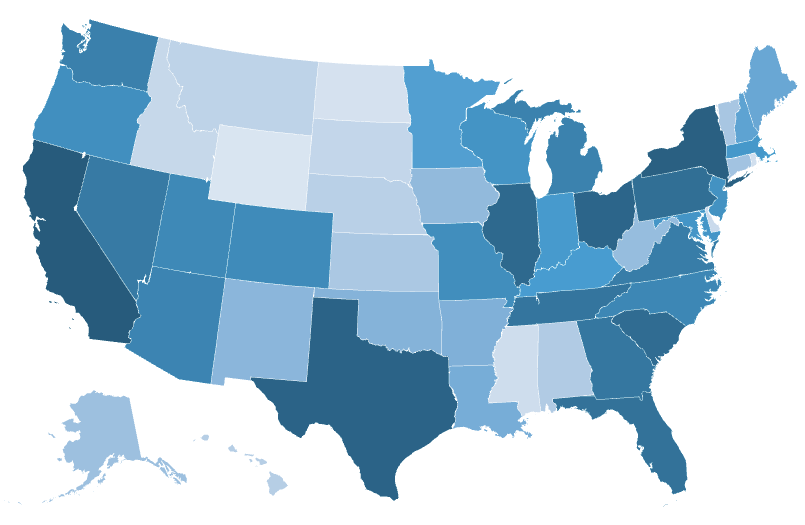
2025 Data Update — Government Impersonation Scam Losses by State
Source: FBI IC3 2025 Annual Report. National 60+ total: $413,206,251 in losses from 8,628 senior victims. The state figures below are state-level reported losses (the per-state amounts sum to about $427.9 million; the national 60+ headline figure of $413.2 million is the all-states 60+ chapter total). View all crime types on the national hub page.
| Rank | State / Territory | 2025 Loss | 2024 Loss | Change |
| 1 | California | $118,886,430 | $43,867,529 | +171% |
| 2 | Texas | $42,927,096 | $12,314,608 | +249% |
| 3 | New York | $30,654,073 | $14,771,954 | +108% |
| 4 | Florida | $24,984,669 | $8,230,216 | +204% |
| 5 | Illinois | $16,040,576 | $9,407,033 | +71% |
| 6 | Washington | $15,715,514 | $5,900,010 | +166% |
| 7 | Virginia | $14,600,318 | $6,754,487 | +116% |
| 8 | Michigan | $11,484,507 | $5,692,098 | +102% |
| 9 | South Carolina | $11,178,321 | $9,134,309 | +22% |
| 10 | Indiana | $10,920,023 | $2,265,961 | +382% |
| 11 | Pennsylvania | $10,664,920 | $8,733,820 | +22% |
| 12 | New Jersey | $10,153,588 | $3,899,187 | +160% |
| 13 | North Carolina | $8,176,425 | $5,032,613 | +62% |
| 14 | Georgia | $8,159,101 | $6,913,124 | +18% |
| 15 | Ohio | $7,877,082 | $9,558,840 | -18% |
| 16 | Maryland | $7,581,628 | $3,148,819 | +141% |
| 17 | Colorado | $7,425,723 | $4,448,272 | +67% |
| 18 | Kansas | $7,261,224 | $584,210 | +1143% |
| 19 | Arizona | $6,692,640 | $5,604,144 | +19% |
| 20 | Nevada | $4,477,783 | $6,909,685 | -35% |
| 21 | Wisconsin | $4,426,146 | $3,500,307 | +26% |
| 22 | New Mexico | $4,128,342 | $912,252 | +353% |
| 23 | Missouri | $3,570,436 | $4,366,024 | -18% |
| 24 | Oregon | $3,053,374 | $4,240,736 | -28% |
| 25 | Massachusetts | $2,733,688 | $2,833,571 | -4% |
| 26 | Oklahoma | $2,697,000 | $1,045,810 | +158% |
| 27 | Kentucky | $2,545,860 | $2,248,787 | +13% |
| 28 | Minnesota | $2,509,444 | $1,700,339 | +48% |
| 29 | Alabama | $2,476,885 | $533,055 | +365% |
| 30 | Utah | $2,273,054 | $4,725,593 | -52% |
| 31 | Tennessee | $2,119,696 | $7,733,586 | -73% |
| 32 | South Dakota | $2,082,172 | $264,301 | +688% |
| 33 | Connecticut | $1,989,183 | $687,298 | +189% |
| 34 | Hawaii | $1,666,964 | $483,660 | +245% |
| 35 | Mississippi | $1,666,063 | $143,540 | +1061% |
| 36 | Rhode Island | $1,439,301 | $92,020 | +1464% |
| 37 | Montana | $1,284,033 | $294,940 | +335% |
| 38 | Arkansas | $1,215,374 | $1,047,559 | +16% |
| 39 | West Virginia | $1,189,120 | $804,125 | +48% |
| 40 | Idaho | $1,092,551 | $212,217 | +415% |
| 41 | Delaware | $1,070,568 | $187,370 | +471% |
| 42 | New Hampshire | $963,851 | $1,533,153 | -37% |
| 43 | Vermont | $961,949 | $623,501 | +54% |
| 44 | District of Columbia | $522,287 | $1,161,895 | -55% |
| 45 | Nebraska | $508,970 | $335,847 | +52% |
| 46 | Iowa | $431,400 | $822,716 | -48% |
| 47 | Louisiana | $363,341 | $1,122,021 | -68% |
| 48 | Alaska | $320,657 | $748,439 | -57% |
| 49 | Maine | $313,613 | $1,461,458 | -79% |
| 50 | Puerto Rico | $248,519 | $23,000 | +981% |
| 51 | Wyoming | $122,400 | $39,270 | +212% |
| 52 | North Dakota | $32,800 | $61,000 | -46% |
Red Flags of a Government Impersonation Scam:
- Unsolicited calls or messages claiming urgent legal or financial trouble
- Requests for payment by gift card, wire transfer, or cryptocurrency
- Threats of immediate arrest, deportation, or loss of government benefits
- Pressure to act quickly and not consult anyone else
- Requests for personal information like Social Security number or bank account details
Why Are Seniors Targeted?
- Seniors may be more trusting of authority and less familiar with scam tactics
- Many rely on Social Security, Medicare, or other benefits and fear losing them
- Criminals hope to scare victims into quick action before they verify the claims
Free one-on-one Medicare help: the State Health Insurance Assistance Program (SHIP) offers free, unbiased Medicare counseling in every state, DC, and US territories. Use it before making any Medicare decision — and especially when you receive an unsolicited call, email, or text about Medicare. Find your local SHIP at shiphelp.org or call the national technical-assistance line at 1-877-839-2675.
How to Protect Yourself:
- Remember: Real government agencies never demand payment by gift card, wire transfer, or cryptocurrency
- The IRS, Social Security, Medicare, and law enforcement do not threaten arrest over the phone or demand personal details by email or text
- Never provide personal or financial information in response to unexpected contact
- If in doubt, hang up and call the agency directly using the number from their official website
- Talk to a trusted family member or friend before sending money or information
- You can follow our training to further enhance your knowledge and skills against government impersonation scam.
If You Suspect a Government Impersonation Scam:
- Hang up immediately and do not engage
- Do not send money or share personal information
- Report the scam to the Federal Trade Commission (ftc.gov), Social Security Administration Office of Inspector General (oig.ssa.gov), or the FBI’s Internet Crime Complaint Center (ic3.gov)
- Notify your bank if money was sent or sensitive information was shared
Documented Government Impersonation Scam Cases
Three reported cases drawn from federal indictments, sentencings, and news investigations — anonymized, with identifying details of victims and defendants removed, and reported by date and dollar amount — illustrating how government impersonation scams play out against older adults in practice.
Carlsbad, CA woman — $1.49 million stolen via fake federal-agent gold-bar scheme (Dec. 2025)
A Carlsbad woman lost $1.49 million after scammers impersonated tech support, then bank officials, then “federal agents” over two months. The pretext: her savings needed protection by being converted to gold bars and stored in a fictitious U.S. Treasury “locker.” She made three wire transfers totaling $1,335,000 to a San Marcos precious metals business, picked up the gold bars, and handed them to couriers. The FBI ran a sting operation on a final $100,000 pickup. Two defendants pleaded guilty in federal court. The case was investigated by the San Diego Elder Justice Task Force. Source: CBS 8 San Diego, Dec. 4, 2025.
Wisconsin “Janet” — coerced for hours by scammers posing as Medicare, her pharmacy, and her doctor (Oct. 2025)
A Wisconsin woman identified only as “Janet” was kept on the phone for hours by scammers impersonating Medicare staff. The lead caller claimed to have worked for Medicare for 29 years and told Janet her benefits had been terminated. The operation included follow-up calls from people posing as her pharmacy and her own doctor, all coordinated to coerce her into providing her Medicare number. Within days, unwanted braces and medical equipment began arriving at her home, which she refused on delivery. Wisconsin’s Senior Medicare Patrol (find your local SMP at smpresource.org or call 1-877-808-2468) (SMP) emphasizes: “Medicare does not take away anyone’s benefits, and Medicare will never contact you unsolicited.” Source: WFSB / InvestigateTV, Oct. 20, 2025.
DOJ Save Our Seniors initiative — Buffalo man lost $40,000 to FTC impersonators (Sept. 2025)
As part of the U.S. Attorney’s “Save Our Seniors” initiative, two money mules were charged with wire fraud and money laundering. Among the documented victims: a 68-year-old man from Orchard Park, NY who lost $40,000 after scammers posed as Federal Trade Commission agents and demanded payment. The broader Save Our Seniors initiative uncovered $11 million in actual and attempted losses across 139 victims nationally. Source: WKYC-TV / U.S. Attorney’s Office WDNY, Sept. 19, 2025.
Frequently Asked Questions
Common questions about how government impersonation scams work and how to respond.
What is a government impersonation scam?
A government impersonation scam is a fraud where criminals pose as the IRS, Social Security Administration, Medicare, FBI, FTC, or local police to threaten or extract money from older adults. Common scripts: your SSN has been “suspended,” you owe back taxes, your Medicare benefits will be terminated, or there is a warrant for your arrest. In 2025 the FBI recorded $413 million in losses from victims age 60+.
Will the IRS or Social Security ever call me?
Almost never. The IRS communicates by U.S. Mail for initial contact. Social Security may send letters or, very rarely, follow up on something you already initiated. Neither will demand immediate payment, threaten arrest, ask for gift cards, or request you wire money to a “safe” account. If you receive such a call, it is a scam. Hang up.
How do I know if a call from the “FBI” or “federal agent” is real?
The FBI does not call private citizens to threaten arrest or demand payment to clear warrants. Federal agents do not warn you against contacting family or attorneys. If you receive such a call, it is a scam. Hang up. If you are genuinely concerned there is an issue, call your local FBI field office directly using a number from fbi.gov/contact-us/field-offices.
My Social Security number has been “suspended.” What does that mean?
Nothing — because Social Security numbers cannot be suspended. This is a scam script designed to panic you into “protecting” your money by withdrawing it or converting it to gift cards or gold. Hang up. Verify by calling the SSA directly at 1-800-772-1213 or report the scam at oig.ssa.gov/scam.
What if a scammer knows part of my personal information?
Partial information — last four of SSN, address, names of family members — is often available from data breaches, public records, or social media. Knowing a real detail does not prove the caller is legitimate. Hang up and verify through an independent channel.
What is the gold-bar “safekeeping” scam?
A growing variant of government impersonation: scammers convince the victim that their savings must be converted to gold or cash and handed to a “federal courier” for safekeeping. This is always a scam. Real federal agencies will never ask you to convert your money to gold or precious metals. See our documented case below: a Carlsbad, CA woman lost $1.49 million this way in 2025.
What if the call shows a real government number on caller ID?
Caller ID can be spoofed in seconds. Scammers regularly display real IRS, FBI, or local police numbers to make their calls appear authentic. Never trust caller ID alone. Hang up and call the agency back using a number you look up independently from the agency’s official website (a .gov address).
Where do I report a government impersonation scam?
Report to: FBI IC3, FTC ReportFraud, the agency being impersonated (SSA OIG at oig.ssa.gov/scam, IRS phishing at [email protected]), your state Attorney General, and the U.S. Department of Justice Elder Fraud Hotline at 1-833-FRAUD-11 (1-833-372-8311).
State-Specific Government Impersonation Scam Resources
Find detailed government impersonation scam prevention guides and local reporting contacts for your state:
- California Government Impersonation Scam Resources – $118.9M lost by CA seniors to government-impersonation scams (2025)
- Texas Government Impersonation Scam Resources
- Florida Government Impersonation Scam Resources
- New York Government Impersonation Scam Resources
- Arizona Government Impersonation Scam Resources
- Pennsylvania Government Impersonation Scam Resources
- Vermont Government Impersonation Scam Resources
View national elder fraud statistics | Find your state Attorney General
Real cases (anonymized from public news coverage)
Real cases of government-impersonation scams from public news reporting, with names and identifying details removed. These scams now routinely combine multiple fake agencies, doctored documents, and sustained phone or video contact.
December 2025 — Fort Worth, Texas. An 84-year-old woman lost approximately $600,000 over several weeks to scammers claiming to be FBI agents. She received daily calls and was sent doctored documents resembling FBI warrants and badges. Instructed to convert her trust funds into gold bars, she handed roughly $500,000 in gold to a ‘courier’ in a parking lot near a closed restaurant — a location chosen because it had no cameras and no witnesses. As reported by WFAA News.
August 2025 — Sacramento, California. A 74-year-old woman lost more than $28,000 — her full nest egg — to scammers who first impersonated PayPal customer support and then a ‘Social Security financial officer.’ One of the scammers came physically to her home to collect cash she had wrapped in a cardboard box. As reported by CBS News Sacramento.
February 2026 — Texas (statewide investigation). Texas authorities exposed a crime ring that allegedly stole at least $55 million from elderly victims across the state. The scheme combined fake federal-agent calls with conversion of victim funds into gold bars and cryptocurrency, with two local jewelry stores allegedly playing roles in the laundering chain. As reported by Yahoo Finance (citing local NBC News).
Recent news coverage
Selected recent news coverage on government-impersonation scam scams targeting older adults. Updated from our ongoing monitoring of US news sources.
- May 2026 — Packages Of Cash Sent To Abandoned House Revealed A Multi-State Scam Case — Patch (Patch)
- Mar 2026 — Attorney General Mayes and Better Business Bureau Warn Arizonans: Don’t Fall for Tax (azag.gov)
- Mar 2026 — CORREA, MEUSER INTRODUCE BIPARTISAN BILL TO CRACKDOWN ON PREDATORY (correa.house.gov)
- Feb 2026 — AMAC Participates in SSA “Slam the Scam” Initiative to Protect Seniors (amac.us)
- Feb 2026 — $55M stolen in alleged impersonation scam involving cash, gold and crypto in Texas. How (AOL)
- Feb 2026 — Texans lose $55M in alleged gold and crypto impersonation scam. How to spot the warning (Yahoo Finance)
Related guides on this site
- Real cases where senior scam victims got their money back
- Phantom Hacker Scams — fake-FBI multi-phase imposter scheme that has drained $1B+ from seniors
- DOJ Elder Fraud Prosecutions Tracker
- Bitcoin ATM & Crypto Kiosk Scams
- Emergency: scammer threatening me now
- Tax Season Scam Guide (IRS impersonation)
Sources & verification. Published by HCSK Inc. The information on this page is based on official federal data from the FBI Internet Crime Complaint Center (IC3), the Federal Trade Commission (FTC), and the Social Security Administration. We last checked these figures against the original government sources in June 2026.
The national picture. These scams are part of a much bigger story. In 2025, Americans 60 and older reported losing $7.748 billion to online fraud across 201,266 victims. Read Stolen Trust, our 2026 special study that maps the full elder-fraud landscape, with five years of FBI data and one practical plan to fix it.
Recent Impersonation Scam News
Recent impersonation-scam news affecting seniors, updated from our alerts desk. Each item links to the original outlet; victims and defendants are kept anonymous.
Michigan senior loses $270,000 in retirement savings to a fake FTC email
A Hazel Park, Michigan resident received a fraudulent email claiming to be from the FTC, telling her she faced arrest over an alleged drug-trafficking and money-laundering case tied to a vehicle supposedly linked to her. The message directed her to call a fake "agent in charge," who told her to buy gold to resolve the fabricated charges; when that was not enough, she was coerced into withdrawing money from both her own and her late husband's pension accounts, losing more than $270,000 in total. The FTC's own guidance is direct: a real government agency will never call, email, text, or message you on social media to ask for money or personal information. If you are contacted by someone claiming to represent a government agency, hang up or stop replying, resist any pressure to act urgently, and independently verify the agency's real phone number before calling back.
Read at Yahoo Finance →Utah woman loses $70,000 after a fake bank fraud call; police renew warnings
An 83-year-old Utah County woman lost $70,000 after a caller impersonating her bank told her fraudulent activity had been detected on her account and that the FBI needed to "examine" her cash. She withdrew $70,000 in two batches and handed it to a rideshare driver in a Provo parking lot, who, without knowing what he was carrying, delivered it to an unidentified man in Salt Lake City. Police are renewing their warnings as the Internet Crime Complaint Center reported roughly 453,000 cyber-fraud complaints nationwide last year, with losses topping $17.7 billion across all types of internet crime. Their advice: if your bank calls, hang up and call them back using the number on your card or statement, watch for high-pressure, time-sensitive requests, and check in regularly with elderly family members about anything unusual on their accounts.
Read at KSL →Texas gold scam: scammers posing as officials stole $250 million from more than 200 elderly Tarrant County residents
In a scheme centered on Tarrant County, Texas, callers posing as bank representatives, government officials, or law enforcement convinced more than 200 elderly victims that their finances or identity had been compromised. Victims were told to withdraw their savings and convert the money into gold bars, cryptocurrency, or cash, then hand it to someone posing as a federal agent who promised to keep it "safe." Investigators say the scheme funneled more than $250 million through a network of callers, couriers, and jewelry businesses, with the stolen assets laundered through shell companies and moved overseas. No real government agency will ever ask you to buy gold, cryptocurrency, or withdraw cash for someone to collect, and legitimate officials will never contact you using a phone number or link they provide themselves. If you get a call like this, hang up and verify by contacting the agency or your bank directly using a number you look up on your own.
Read at Yahoo News →A McAllen, Texas family warns after scammers visited elderly parents in person claiming to be from Medicare
A McAllen, Texas woman is warning others after her elderly parents were targeted by scammers who first called claiming to represent Medicare, then showed up at their home in person. The visitor photographed both parents' Medicare cards and had them sign documents, without leaving any copies or identification behind. FBI officials say elder fraud complaints and losses have doubled recently, with Americans 60 and older reporting more than 200,000 fraud complaints in 2025 and losses of roughly $7.8 billion, an average of about $38,500 per victim. An FBI official in the region said no legitimate government agency, bank, or technology company will ever tell you to move money to protect it, and urged families to verify any caller's identity before sharing information and to approach a loved one who has been scammed with support rather than shame. Anyone targeted should contact the National Elder Fraud Hotline at 1-833-372-8311.
Read at KRGV →Naples, Florida police recover $10,000 an elder-fraud victim had shipped to California
Naples, Florida police say an older resident was contacted by scammers posing as a legitimate government agency and, using fear and urgency, convinced to withdraw $10,000 in cash and ship it overnight to an address in California. After the victim reported the fraud, the department's Cyber Crimes Unit worked with UPS and law enforcement in California to intercept the package before it arrived, and the full $10,000 was recovered and is being returned to the victim. Investigators say pressure to act immediately, and any demand for cash, are the clearest red flags: no real government agency will ever contact you and demand money. Police say recovering money after a scam is often very difficult, especially once cryptocurrency or gift cards are involved, so the best defense is to slow down, take a breath, and, if you do send money, cut off contact with the scammer and report it right away.
Read at Gulf Coast News (WBBH) →Fake 'MyChart Medicare Kit' texts and emails are phishing for Medicare patients' information
University Health is warning Medicare patients about a nationwide phishing scam using fake emails and text messages that impersonate MyChart, a real hospital patient-portal system. Messages with subject lines like "Your MyChart Medicare Kit Awaits" or "Here's your senior package" advertise free goods and services and try to get recipients to click a link that exposes their personal information. Officials say to be skeptical of any unsolicited offer of free items tied to Medicare, since the real Epic and MyChart systems do not send these kinds of offers. So far, no confirmed cases of patient information being compromised have been reported. The safe move: do not click links in unexpected texts or emails, check the actual web address before clicking anything, and if you are unsure whether a message is real, contact your health provider directly using a number you look up yourself.
Read at KSAT →