

Protecting Seniors From Extortion Scams: How to Spot, Prevent, and Report Fraud
Extortion scams cost American seniors $52.5 million in 2025, growing +114% year-over-year and +184% over five years. The most damaging current variants are AI-powered “digital arrest” scams (fake federal agents on deepfake video demanding payment to avoid arrest) and AI-generated sextortion targeting older men with fabricated compromising images. The single best defense: no real law enforcement, federal agency, or court official will ever demand payment by gift card, cryptocurrency, or cash to avoid arrest. Hang up immediately and report.
Last updated: May 15, 2026 · Primary sources: FBI IC3 2025 Annual Report, FTC, DOJ Elder Justice, plus our news corpus of 1,910 parseable elder-fraud articles.
- What Is an Extortion Scam Targeting Seniors?
- How Do Extortion Scams Work?
- Common Types of Extortion Scams Affecting Seniors
- US Heat Map — Extortion Scams Targeting Seniors (2025)
- Seniors Affected by State (2025 FBI Data)
- Red Flags of an Extortion Scam
- Why Are Seniors Targeted?
- How To Protect Yourself
- If You Are Being Extorted
Extortion scams cost American seniors $52.5 million in 2025, with 10,026 victims aged 60 and older — one of the highest victim counts across all fraud types. Criminals use threats of arrest, fake warrants, sextortion, and public embarrassment to demand payment. This guide covers how extortion scams targeting seniors work, how to recognize them, and what to do if you receive threatening demands.
Already been scammed? Read our First 24 Hours Emergency Guide for critical steps to take immediately.
Audience-Specific Guides: Extortion-style scams target specific communities with specific threats. See our: USCIS and Immigration Scams — fake deportation and ICE-arrest threats targeting senior immigrants; Senior Veterans Scam Protection — fake VA threats targeting veteran benefits; Caregiver Scam Defense Center — when an older parent is being threatened over the phone.
Not sure what a term means? Our Scam & Cybersecurity Glossary explains 77 common scam and cybersecurity terms in plain English.
What Is an Extortion Scam Targeting Seniors?
An extortion scam is a crime in which scammers threaten to harm, embarrass, or expose a senior unless they pay money. Unlike other scams that lure victims with promises, extortion relies on fear — threatening to reveal private information, damage reputations, or even cause physical harm. The threats are almost always fake, but they feel terrifyingly real.
In 2025, 10,026 seniors reported extortion attempts to the FBI, with losses totaling $52.5 million. The rise of artificial intelligence has made these scams more convincing than ever, with scammers now able to generate fake images, clone voices, and create realistic but entirely fabricated “evidence.”
How Do Extortion Scams Work?
Extortion scammers typically contact victims through email, text messages, phone calls, or social media. The approach follows a common pattern:
- The threat: The scammer claims to have compromising information, photos, videos, or evidence of wrongdoing. They may reference a real password or personal detail (often obtained from old data breaches) to seem credible.
- The demand: Payment is demanded, almost always in cryptocurrency (Bitcoin), gift cards, or wire transfers — methods that cannot be reversed or traced.
- The deadline: An urgent time limit is imposed (“you have 24 hours”) to prevent the victim from thinking clearly or seeking help.
- The isolation: Victims are warned not to contact police or tell anyone, or the “consequences will be worse.”
Common Types of Extortion Scams Affecting Seniors:
- Sextortion emails: Mass-sent emails claiming the scammer hacked your computer’s webcam and recorded you visiting adult websites. They threaten to send the video to your contacts unless you pay. These emails are almost always completely fabricated — no recording exists.
- AI-generated sextortion: A rapidly growing threat where scammers use artificial intelligence to create realistic fake intimate images of the victim using publicly available photos from social media. The FBI has issued specific warnings about this alarming trend.
- Grandparent/family emergency extortion: Scammers call pretending to be a grandchild or family member in distress, using AI-cloned voices, and demand immediate payment to resolve a fabricated emergency such as an arrest, accident, or kidnapping.
- Government threat extortion: Calls or messages claiming to be from the IRS, Social Security, or law enforcement, threatening arrest, deportation, or benefit suspension unless payment is made immediately.
- Data breach extortion: Emails referencing a real password (from an old data breach) and claiming to have access to all your accounts, demanding payment to “delete” the information.
US Heat Map — Extortion Scam Losses by State (2025)
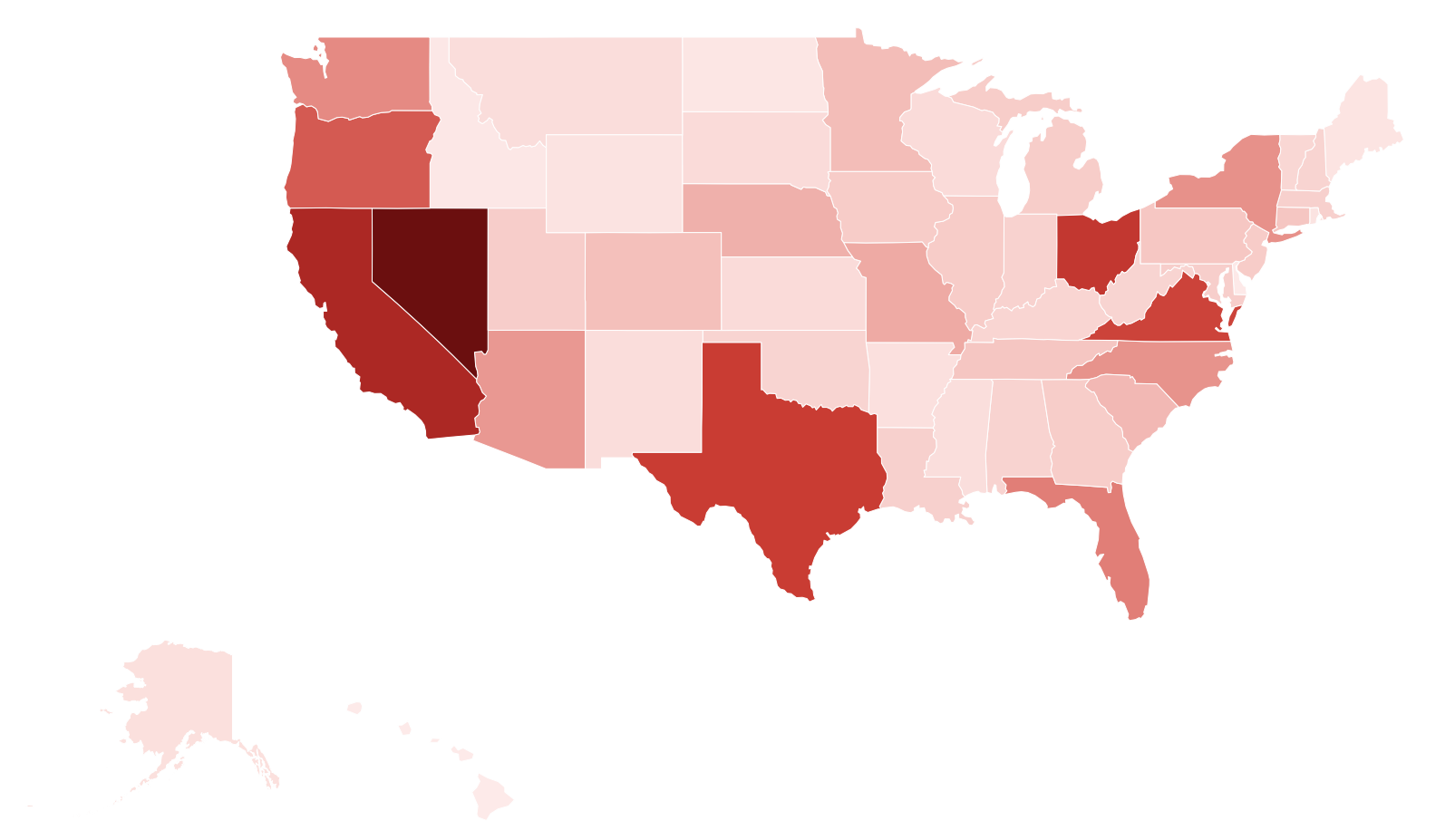
Seniors Affected by State (2025 FBI IC3 Data)
| Rank | State / Territory | Extortion Loss |
| 1 | Nevada | $16,580,372 |
| 2 | California | $7,345,315 |
| 3 | Ohio | $5,187,773 |
| 4 | Texas | $4,590,816 |
| 5 | Virginia | $4,212,313 |
| 6 | Oregon | $2,980,000 |
| 7 | Florida | $1,544,963 |
| 8 | Washington | $1,264,608 |
| 9 | New York | $1,096,111 |
| 10 | North Carolina | $1,054,233 |
| 11 | Arizona | $957,150 |
| 12 | Missouri | $631,283 |
| 13 | Nebraska | $540,807 |
| 14 | South Carolina | $433,073 |
| 15 | Minnesota | $374,189 |
| 16 | Colorado | $353,772 |
| 17 | Connecticut | $275,182 |
| 18 | Tennessee | $267,644 |
| 19 | Pennsylvania | $259,229 |
| 20 | Illinois | $185,023 |
| 21 | New Jersey | $183,201 |
| 22 | Iowa | $182,171 |
| 23 | Michigan | $180,241 |
| 24 | Georgia | $171,837 |
| 25 | Utah | $166,231 |
| 26 | Maryland | $152,396 |
| 27 | Massachusetts | $137,920 |
| 28 | Louisiana | $136,510 |
| 29 | Indiana | $115,824 |
| 30 | Alabama | $111,475 |
| 31 | New Hampshire | $104,200 |
| 32 | Oklahoma | $100,413 |
| 33 | West Virginia | $100,205 |
| 34 | Kentucky | $90,776 |
| 35 | Vermont | $72,050 |
| 36 | Wisconsin | $49,362 |
| 37 | South Dakota | $47,055 |
| 38 | Kansas | $45,863 |
| 39 | New Mexico | $38,182 |
| 40 | Montana | $36,462 |
| 41 | Mississippi | $34,540 |
| 42 | Alaska | $27,200 |
| 43 | Arkansas | $23,650 |
| 44 | Puerto Rico | $19,420 |
| 45 | Wyoming | $15,461 |
| 46 | Rhode Island | $14,050 |
| 47 | Maine | $13,479 |
| 48 | North Dakota | $9,450 |
| 49 | Idaho | $5,525 |
| 50 | Delaware | $3,628 |
| 51 | Hawaii | $2,500 |
| 52 | District of Columbia | $0 |
Red Flags of an Extortion Scam:
- An unsolicited message threatens to expose private information or cause harm
- Payment is demanded in cryptocurrency, gift cards, or wire transfers
- The message includes a password or personal detail you recognize (likely from an old data breach — this does not mean they have access to your computer)
- An urgent deadline is imposed with threats of escalation
- You are told not to contact police or tell anyone
- The tone is designed to create panic and prevent rational thinking
Why Are Seniors Targeted?
- Older adults may feel more shame or embarrassment about the threats, making them less likely to seek help
- Seniors may not understand that AI can generate completely fake images or clone voices, making threats seem more credible
- Fear of family members seeing the threats can be overwhelming, leading to quick payment rather than investigation
- Scammers exploit the fact that many seniors are less familiar with how data breaches work and may believe a leaked password means full access to their computer
How to Protect Yourself:
- Do not pay. Paying never makes extortionists go away — it marks you as someone who will pay, leading to more demands
- Do not respond to the scammer. Any response confirms you are a live target
- Understand that AI can fake anything — photos, videos, and voices can all be artificially generated. A threatening image or recording does not mean a real event occurred
- If an email references one of your passwords, change that password immediately on any account where you still use it, and enable two-factor authentication
- Limit personal information and photos shared publicly on social media, as scammers use these to create AI-generated content
- Establish a family code word that can verify identity in case of emergency calls claiming a family member is in danger
If You Are Being Extorted:
- Do not pay and do not respond
- Save all messages, emails, and communications as evidence — take screenshots
- Report it immediately to the FBI’s Internet Crime Complaint Center (ic3.gov) and your local police
- If intimate images are involved, report to the National Center for Missing & Exploited Children (CyberTipline) and request removal from platforms
- Tell someone you trust — a family member, friend, or counselor. Extortion thrives on shame and silence
- Contact the Cyber Civil Rights Initiative crisis helpline at 844-878-2274 for support
Remember: Extortion is a crime committed against you — you are the victim, not the wrongdoer. No matter what the scammer claims, you have nothing to be ashamed of. The threats are designed to isolate you. Speaking up is the most powerful thing you can do.
5-Year National Trend: Extortion Scams Against Seniors (2021—2025)
According to five years of FBI IC3 data, extortion scams targeting Americans aged 60 and older have exploded, growing +184% since 2021. Over this period, seniors reported 40,083 incidents with combined losses of $133 million. The peak year was 2025, with $52,525,133 in reported losses.
| Year | Victims (60+) | Total Losses | % of All Elder Fraud | YoY Change |
| 2021 | 5,860 | $18,472,665 | 1.2% | — |
| 2022 | 4,189 | $15,223,029 | 0.5% | -18% |
| 2023 | 5,568 | $22,515,127 | 0.7% | +48% |
| 2024 | 14,440 | $24,491,921 | 0.5% | +9% |
| 2025 | 10,026 | $52,525,133 | 0.7% | +114% |
| 5-Year Total | 40,083 | $133,227,875 | 0.7% | +184% (2021—2025) |
Source: FBI Internet Crime Complaint Center (IC3) elder-fraud reports, 2021—2025, summed across the 52 state and territory files (victims age 60 and older). “% of All Elder Fraud” shows this crime type’s share of total elder fraud losses that year.
Reported Extortion Scam Cases (Anonymized)
Three reported cases from federal actions, sentencings, and news investigations — anonymized, with identifying details of victims and defendants removed, retaining dates and dollar amounts — illustrating how extortion scams play out against older adults in practice.
FBI 2025 Annual Report — extortion losses against seniors more than doubled year-over-year (+114%)
The FBI Internet Crime Complaint Center documented $52.5 million in extortion losses from victims age 60+ in 2025, up from $24.5 million in 2024 — a +114% year-over-year increase. Over five years extortion losses against seniors have grown +184%. Reported victim counts: 10,026 in 2025. These numbers represent only cases where victims came forward; the true scale, given the stigma of digital-arrest and sextortion threats, is likely substantially higher. Source: FBI IC3 2025 Annual Report.
Digital-arrest pattern — AI-generated arrest warrants and deepfake federal agents (2025–2026)
Across 2025 and into early 2026, India, the U.S., and the UK have all seen surging digital-arrest scam reports. The pattern: a victim receives a call from someone posing as a federal agent, is told there is a warrant for their arrest related to drug trafficking or financial crime, is forced onto a video call with a fake “judge,” and is kept on the line for hours while being instructed to liquidate accounts and transfer funds to “clear” the warrant. Victims report being shown AI-generated arrest documents bearing their real names and addresses. No legitimate court or agency operates this way. Source: The420.in / India enforcement coverage, Oct. 31, 2025.
Pennsylvania state hearing — a state representative’s mother defrauded of $40,000 over two years (Mar. 2026)
A Pennsylvania state representative chaired a House Majority Policy Committee hearing on senior scams in 2026 after revealing that his own mother had been defrauded of nearly $40,000 over two years. Pennsylvania reported over $76 million in senior scam losses for 2025 alone across more than 4,000 complaints. The hearing revealed that extortion patterns, especially those exploiting social-media-targeted seniors, are now the fastest-growing harm category statewide. Source: Warminster Patch, Mar. 1, 2026.
Frequently Asked Questions
Plain answers to the most common questions about extortion, digital arrest, and sextortion scams targeting older adults.
What is an extortion scam?
An extortion scam uses threats, fear, or claimed compromising material to coerce money from the victim. Common variants targeting seniors include digital-arrest scams (fake federal agents threatening arrest), sextortion (fake compromising images or videos), threatened-family scams (claim a relative will be harmed), and IRS/legal extortion (pay or be jailed). In 2025 the FBI recorded $52.5 million in losses from victims age 60+.
What is a “digital arrest” scam?
A digital arrest scam uses AI-generated fake arrest warrants, court documents, and deepfake video calls with people posing as judges, federal agents, prosecutors, or police. Victims are told they face imminent arrest unless they pay “bail” or “clearance fees” immediately, and are forbidden from contacting family or attorneys. No U.S. law enforcement agency operates this way. Hang up and call 911 if you feel threatened.
What is sextortion and does it target older adults?
Sextortion is extortion using compromising sexual content — real, fabricated, or AI-generated. While teen boys are the most-publicized victims, older men are an increasing target as AI image-generators can produce fake compromising images from a single profile photo. Common script: scammer claims to have webcam recordings or compromising photos and demands payment in cryptocurrency or gift cards. The threat is almost always empty.
Should I pay the demand to make it go away?
No. Paying does not make extortion stop — it confirms you are a paying target and triggers escalating demands. The threatened material is almost always fabricated. The correct response is: preserve all communications, do not engage further, and report to the FBI at ic3.gov and to local police.
How do extortion scammers know my real personal information?
Through data breaches (your address, partial SSN, family names), public records, or social media. Knowing a real detail does not prove the threat is real. Scammers buy stolen data on the dark web and use it to make their threats sound credible.
What if the caller claims to be FBI, ICE, or local police?
Hang up. No federal or local law-enforcement agency calls private citizens to threaten arrest or demand payment. They do not warn you against telling family or lawyers. They do not accept payment by gift card, crypto, wire to a ‘safe account,’ or cash to a courier. If you are genuinely concerned, look up your local FBI field office or police department from their official .gov website and call back.
My parent is being threatened. What do we do right now?
Have them hang up immediately and not answer if the caller redials. Document the call (time, number, what was said). Do not send any money. Report at ic3.gov mentioning “digital arrest” or “sextortion” specifically, contact local police on the non-emergency line, and call our First 24 Hours Emergency Guide for the full sequence.
Are extortion scams getting worse?
Yes — sharply. Reported senior extortion losses grew +114% from 2024 to 2025 alone and +184% over five years. AI is the main accelerant: AI-generated arrest warrants, deepfake video of fake federal agents, and AI-fabricated compromising images make threats more believable than ever. Expect this category to keep growing through 2026.
AI Is Changing How These Scams Work
AI has made extortion scams far more terrifying. Criminals now use AI to generate fake arrest warrants and court documents with the victim’s real personal information, conduct deepfake video calls with fake “judges” and “law enforcement agents,” and clone the voices of real officials. The “digital arrest” scam — where victims are kept on continuous calls while being threatened with imminent arrest — is one of the fastest-growing AI-powered fraud types in 2025.
In 2025, the FBI received 22,364 complaints citing AI as a tool in fraud, with losses exceeding $893 million. For seniors aged 60+, AI-related fraud accounted for $352 million in reported losses — and these numbers represent only cases where victims recognized AI was involved.
Read our complete guide to AI-Powered Scams Targeting Seniors • Digital Arrest Scams • AI Phone Scams • Voice Cloning Scams
2025 FBI Elder Fraud National Data | AI-Powered Scams Hub | Report a Scam / Find Your State Attorney General | Elder Fraud Statistics & Research | Emergency: First 24 Hours Guide
Real cases (anonymized from public news coverage)
Recent extortion-scam cases from public news reporting, with names and identifying details removed. “Sextortion,” fake-arrest threats, and ransom-style demands all appear together in the modern extortion playbook.
February 2026 — Chicago, Illinois. A woman messaging someone on a dating app for months became the target of a ‘sextortion’ scam. When she refused to pay, the scammer used AI to generate fake nude images of her and posted them to her social-media followers. Authorities confirmed that refusing to pay was the correct response — paying never stops the threats. As reported by ABC7 Chicago.
March 2026 — Washington Township, New Jersey. A senior received a phone call appearing to come from her real bank’s number (spoofed caller ID). The caller claimed they could ‘help her obtain more money’ if she first provided funds, then kept her on the phone while she withdrew approximately $83,000. A courier was dispatched to her home to physically collect the cash. She realized later that day she had been scammed. As reported by 6ABC Philadelphia.
December 2025 — Middle District of Louisiana (federal case). Federal authorities announced the forfeiture of over $200,000 in cryptocurrency connected to a scam targeting elderly victims. The forfeiture is one of a growing set of cases in which federal prosecutors are recovering scam proceeds from cryptocurrency wallets. As reported by DOJ press release.
Recent news coverage
Selected recent news coverage on extortion and sextortion scam scams targeting older adults. Updated from our ongoing monitoring of US news sources.
- Mar 2026 — Victim of gift card fraud? Here’s how you may be able to get your money back (Boston 25 News)
- Mar 2026 — Scam campaigns target older Ohioans, but younger adults often fall prey — cleveland.com (cleveland.com)
- Feb 2026 — ‘Sextortion’ warning: Criminals claiming to have inappropriate pictures of victims to demand money (ABC7 Chicago)
Related guides on this site
- Real cases where senior scam victims got their money back
- Phantom Hacker Scams — fake-FBI multi-phase imposter scheme that has drained $1B+ from seniors
- DOJ Elder Fraud Prosecutions Tracker
- Bitcoin ATM & Crypto Kiosk Scams
- Emergency: scammer threatening me now
Sources & verification. Published by HCSK Inc. The information on this page is based on official federal data from the FBI Internet Crime Complaint Center (IC3) and the U.S. Department of Justice. We last checked these figures against the original government sources in June 2026.
The national picture. These scams are part of a much bigger story. In 2025, Americans 60 and older reported losing $7.748 billion to online fraud across 201,266 victims. Read Stolen Trust, our 2026 special study that maps the full elder-fraud landscape, with five years of FBI data and one practical plan to fix it.
Recent Extortion Scam News
Recent extortion-scam news affecting seniors, updated from our alerts desk. Each item links to the original outlet; victims and defendants are kept anonymous.
Scammers falsely accuse seniors of crimes, then demand cash to make it 'go away'
Investigators describe a scheme in which callers falsely tell older adults they are linked to crimes such as online pornography or drug trafficking, then demand cash payments to resolve the fabricated legal trouble. At least 30 victims across 17 states lost more than $2 million combined, with individual losses ranging from $44,000 to $200,000. 'These victims are not wealthy individuals,' investigators said, noting many could not afford losses of that size. Real law enforcement does not call to accuse you of a crime and demand immediate cash to make it disappear, so if you get a call like this, hang up right away and report it to your local police department or the FBI's IC3.gov rather than engaging with the caller.
Read at WFTV →FBI warns deepfake kidnappings and voice clones target seniors
The FBI warns that scammers now use AI to clone voices and fake kidnappings, pressuring seniors to pay fast.
Read at Saving Advice →What banks can actually do to freeze a suspicious transfer from a senior's account
A common claim that banks now have a blanket legal right to freeze any senior's bank transfer for 14 business days is misleading; no such universal rule exists. What does exist is more limited and specific. FINRA Rule 2165 lets brokerage firms, not regular banks, place a temporary hold of 15 to 25 business days, with a possible 30-business-day extension, on a transaction when they reasonably believe a customer age 65 or older is being financially exploited, including through romance scams or fraudulent investment pitches. Separately, newer rules around ACH transfers let financial institutions use risk-based monitoring, flagging unusual transaction amounts, suspicious patterns, or activity that doesn't match a customer's normal history, and various state laws give banks legal protection for acting in good faith when they pause a suspicious transfer. None of this requires a bank to use AI or to automatically block transfers over a certain amount; it depends on the institution and the specific red flags involved. The practical takeaway for families: ask your parent's bank or brokerage directly what exploitation-related hold policies and trusted-contact options it already has in place, rather than assuming a single universal rule protects every account.
Read at Saving Advice →AI is making scams 'indistinguishable' from real banking sites, experts warn
Technology experts say AI has made scams targeting older adults qualitatively harder to detect, with fake banking sites and deepfake videos generated from photos pulled off social media now looking nearly identical to the real thing. A recent survey found that only 7 percent of older adults feel confident protecting their personal information online, and 70 percent said they lack confidence about what happens when they share information with AI chatbots. Experts recommend treating any sensitive financial or health information you type into an AI chatbot like cash: assume it could be exposed. Red flags to watch for include messages that create urgency, such as being told to send money to your bank account within the hour, since that pressure is designed to short-circuit careful thinking. Other recommended defenses: use strong, unique passwords and a password manager, turn on multifactor authentication wherever it's offered, and slow down, verify independently, and think twice before clicking a link or acting on an urgent message.
Read at WZMQ 19 →BBB warns of fall home-repair scams that specifically target older homeowners
The Better Business Bureau says fall is a prime season for home-improvement scams, as door-to-door crews offer fake or unnecessary roof, chimney, gutter, and furnace repairs while the weather turns cooler. Home-improvement scams rank among the riskiest categories tracked by the BBB, with a median reported loss of $1,405. Scammers often show up unannounced, claim to have leftover material from a nearby job, quote an unbelievably low price, accept only cash or check, and push to start work immediately. Older homeowners are a particular target for gutter-cleaning scams, since scammers count on them being less able to check the work themselves, and for fake "free energy audit" offers that claim utility-company affiliation before pushing costly, unnecessary upgrades. The BBB's advice: never hire someone who simply shows up at your door, verify any contractor through BBB.org or similar resources before letting them inspect or work on your home, get everything in writing, and never pay the full amount upfront.
Read at Better Business Bureau (via Quad-City Times) →Fake 'concealed carry permit' ads on Facebook and Instagram are targeting seniors and veterans
Researchers have identified more than 20 advertiser pages that together spent over $3.1 million running scam ads for a nonexistent "national concealed carry permit" on Facebook and Instagram. The ads disproportionately target older adults and veterans, using appeals to patriotism and service alongside fear about crime, home invasion, and geopolitical tension to drive clicks. Some of the ads use AI-generated images and cloned audio to impersonate law enforcement officers, celebrities, or elected officials to appear more credible. At least 10 of the identified pages appear to be operating together as a single coordinated network. These ads violate the platforms' own policies against scams, deceptive business practices, and coordinated inauthentic behavior. The advice: there is no such thing as a "national concealed carry permit" you can buy online, so treat any ad claiming otherwise as a scam, and never click through or provide payment or personal information in response to one. If you see an ad like this, report it to the platform and avoid engaging with it.
Read at Institute for Strategic Dialogue →