

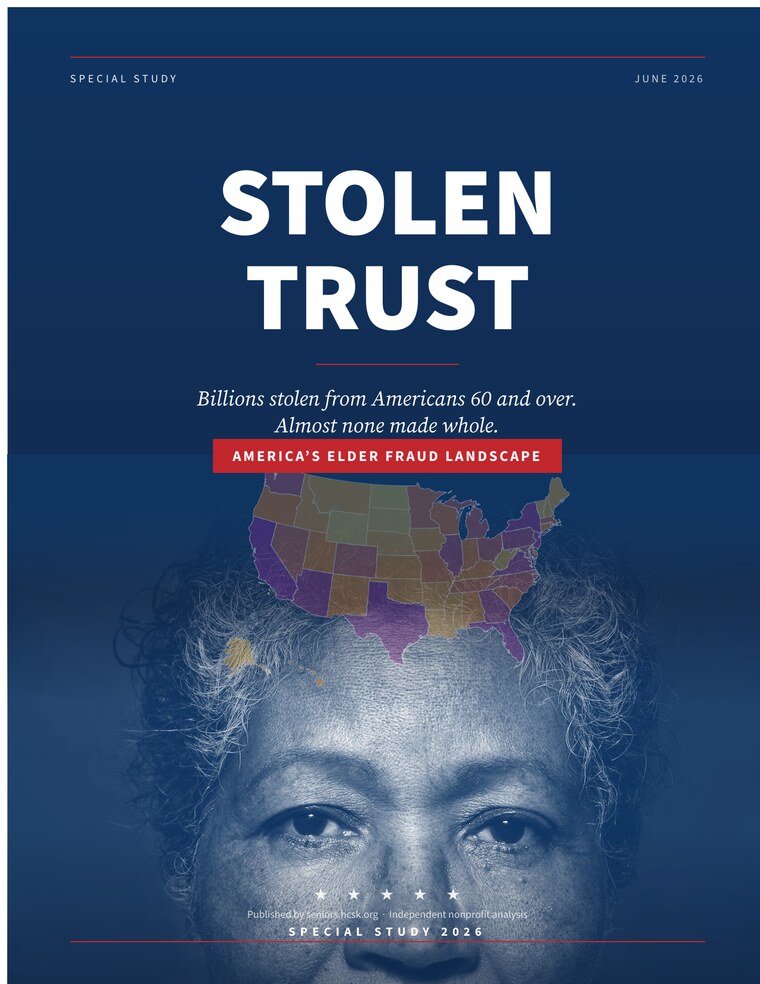

Stolen Trust: A Special Study on America’s Elder Fraud Landscape
Proudly Featured by



In 2025, Americans 60 and older reported losing $7.748 billion to online scams and fraud, across 201,266 victims, up about 360 percent since 2021. Stolen Trust reads federal data and 1,910 news items together to map the whole landscape: the scale, the geography, the criminal methods, the AI escalation, the response, and the human cost. It closes with one proposal, built from infrastructure that already exists, the Three Ones.
Inside the study
Key Findings
The study’s findings at a glance: the scale of the losses, how little is recovered, and the coordination gap the report sets out to close.
Read the key findings online →
Foreword
Why this study exists, what it is and is not, and how it was built, from the study’s author.
Chapter 1: The Numbers
Reported losses for adults 60 and over rose from $1.685 billion in 2021 to $7.748 billion in 2025, up about 360 percent, while only a fraction of stolen money is ever recovered.
Chapter 2: State-by-State Rankings
Four ways to rank all 52 states and territories, by total loss, loss per senior, five-year growth, and how often an older adult is scammed, because no single ranking tells the whole story.
Chapter 3: The Four Scams
The four scam types that drive most losses, with investment fraud now the largest category at $3.519 billion in 2025.
Chapter 4: The AI Escalation
2025 was the first year the FBI tracked AI-related fraud as its own category: $352.5 million in losses, with voice cloning and deepfakes making old scams far more convincing.
Chapter 5: What 10 Months of News Coverage Reveal
An original analysis of 1,910 news articles over ten months: what coverage emphasizes, what it misses, and the gap in AI-scam reporting.
Chapter 6: Who Is Fighting Back
The defense from the kitchen table outward, family, community, states, banks, platforms, and ten federal actors, and why VSAFE shows a single front door already works.
Chapter 7: The Legislative Landscape
What is on the books and what is moving in Congress and the states, from the SCAM and GUARD Acts to crypto-ATM laws, and the coordination gap that remains.
Chapter 8: Beyond the Dollar
The human cost beyond the dollars: the trauma, isolation, and loss of independence fraud inflicts, and why a fast, humane response matters.
Chapter 9: The Proposal: The Three Ones
The study’s proposal, built from infrastructure that already exists: One Front Door, One Message, and One Day, a 24-hour coordinated response standard.